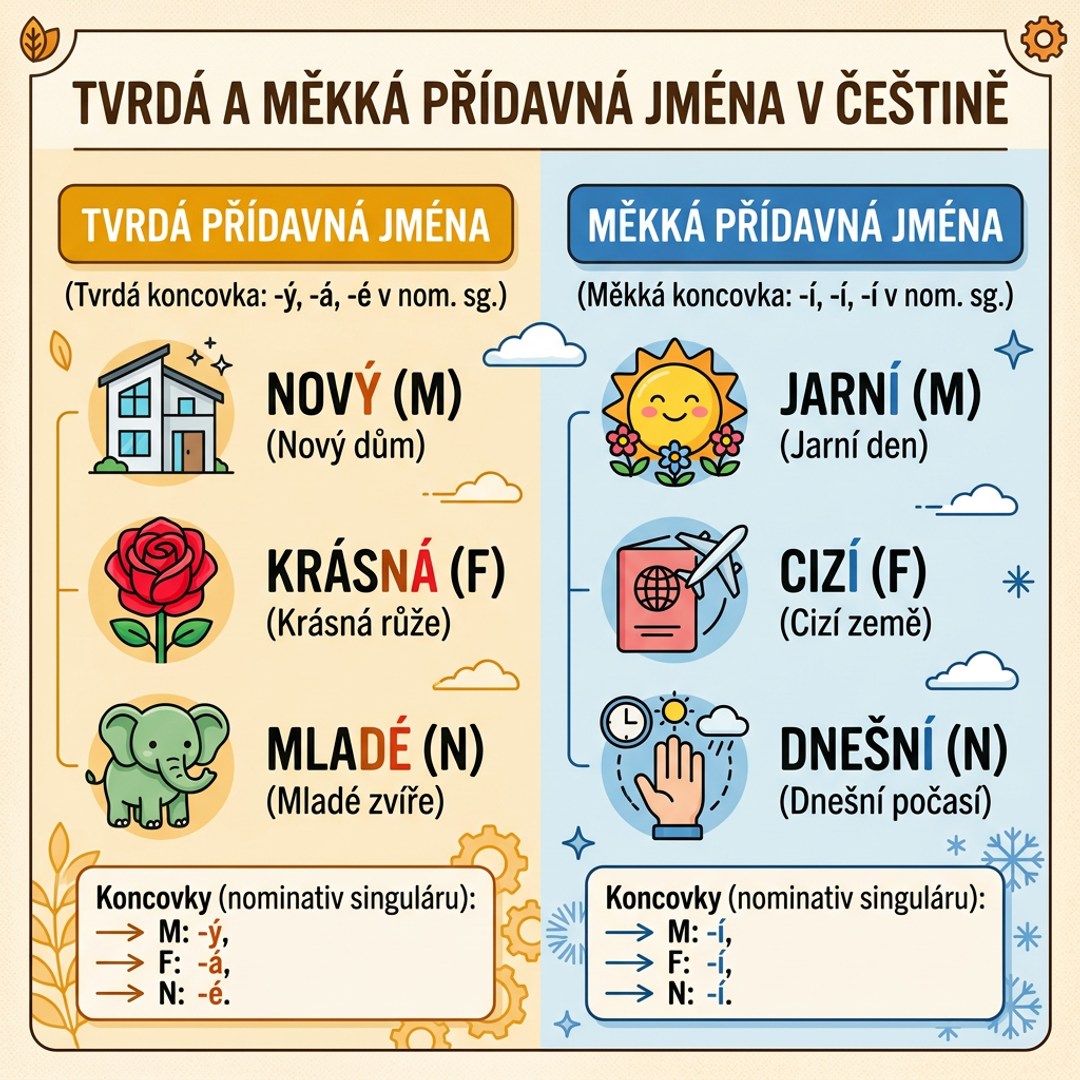
Czech adjectives are primarily divided into two groups for declension: hard and soft. This classification is based on the ending of the adjective.
Hard Adjectives (Tvrdá adjektiva) usually end in -ý.
- Examples:
- nový (new)
- mladý (young)
- dobrý (good)
- The endings are -ý, -á, -é. For instance, the masculine nominative singular is -ý, while the feminine is -á and the neuter -é.
Soft Adjectives (Měkká adjektiva)
- The stem ends in a soft consonant such as c, j, ž, š, č, ř, but also endings such as -ní or -cí.
- The last letter in every gender is always -í.
- Examples:
- cizí (foreign)
- jarní (spring, of spring)
- rybí (fish, of fish)
- The endings are consistently characterized by the soft vowel -í across all genders and numbers. For example, the nominative singular for all genders (masculine, feminine, and neuter) is -í. There are no changes like -ý to -á..
Graded adjectives (comparative and superlative degrees) are automatically the soft type.
What does it mean? Adjectives in Czech can be graded: pomalý (slow) -> pomalejší (slower) -> nejpomalejší (slowest)
Comparison with English:
- Czech: Czech employs specific suffixes to indicate comparative and superlative degrees:
- pomalý (slow) -> pomalejší (slower) -> nejpomalejší (slowest)
- krásný (beautiful) -> krásnější (more beautiful) -> nejkrásnější (most beautiful)
Thus, the basic form of an adjective describes a quality without any comparison. For example:
- pomalý (slow)
- krásný (beautiful)
- starý (old)
Comparative Form
The comparative form is used to compare two things. In Czech, this is typically formed by adding the suffix –ejší, -ější or -ší to the adjective. For example:
- pomalejší (slower) from pomalý
- krásnější (more beautiful) from krásný
- starší (older) from starý
Irregular forms: good – better, bad – worse, tall – taller, etc.
Superlative Form
The superlative form is used to describe the highest degree of a quality among three or more things. This is usually formed by adding the prefix nej- to the comparative form. For example:
- nejpomalejší (slower) from pomalejší
- nejkrásnější (more beautiful) from krásnější
- nejstarší (older) from starší
Irregular comparative and superlative forms
- dobrý (good) – lepší (better) – nejlepší (best)
- špatný (bad) – horší (worse) – nejhorší (worst)
- velký (big) – větší (bigger) – největší (biggest)
- malý (small) – menší (smaller) – nejmenší (smallest)
- lepší (better) from dobrý
- větší (bigger) from velký
- menší (smaller) from malý
- nejlepší (best) from lepší
- největší (biggest) from větší
- nejmenší (smallest) from menší
Share Czech Language Lessons & Translations

📞 (+48 797 387 541). Book a lesson.
…jhijikjh


Napsat komentář