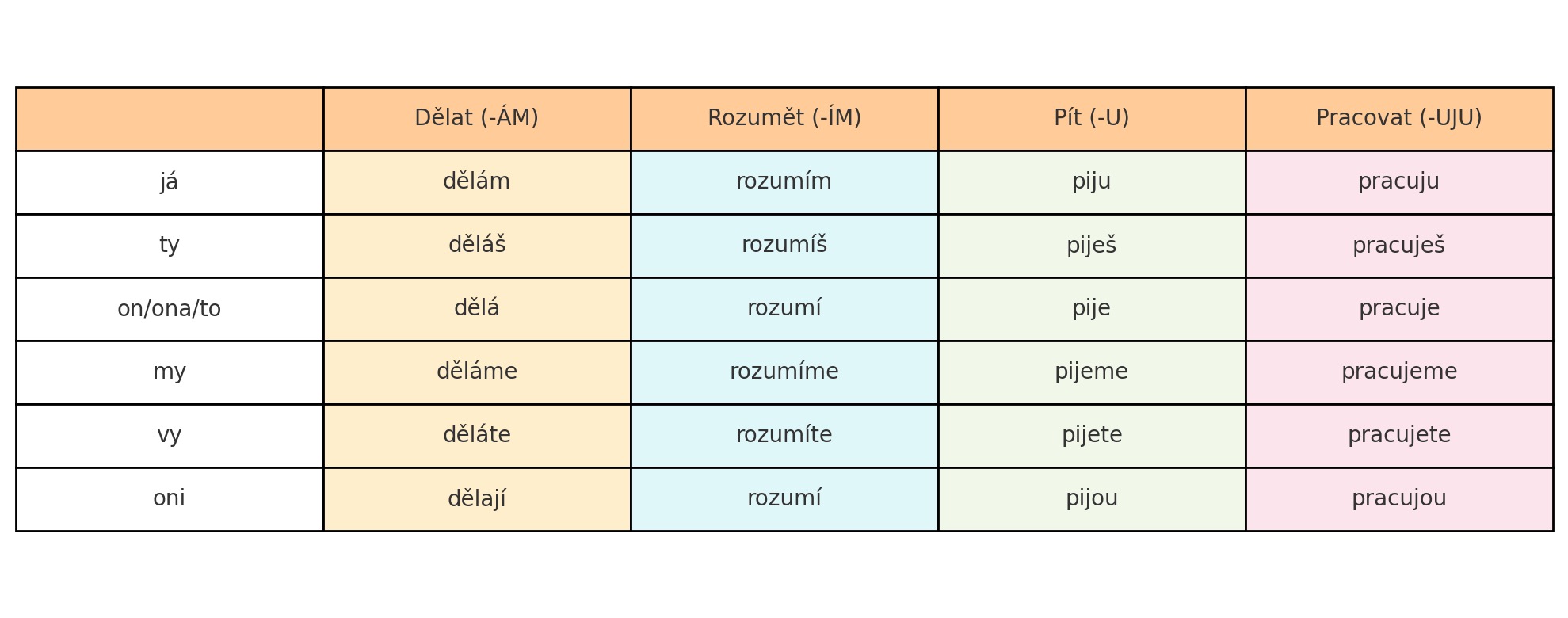
There are three basic types of verb conjugation in Czech:
Each type has its own set of endings for different verb tenses.
| Koncovka -at, -át | Koncovka -it, -et, -ět | Koncovka -ovat | |||
| dělám děláme | mluvím mluvíme | studuju (-i) studujeme | |||
| děláš děláte | mluvíš mluvíte | studuješ studujete | |||
| dělá dělají | mluví mluví | studuje studujou(-í) | |||
| mít | spát | psát | |||
| mám máme | spím spíme | píšu píšeme | |||
| máš máte | spíš spíte | píšeš píšete | |||
| má mají | spí spí | píše píšou | |||
-at Verbs (1st Conjugation):
1. Verbs ending in „-at“ belong to the first conjugation. To conjugate these verbs, you remove the „-at“ ending and add the appropriate endings. For example, the verb „mluvit“ (to speak): – Present tense: mluvím (I speak), mluvíš (you speak), mluví (he/she/it speaks) – Past tense: mluvil jsem (I spoke), mluvil jsi (you spoke), mluvil (he/she/it spoke) – Future tense: budu mluvit (I will speak), budeš mluvit (you will speak), bude mluvit (he/she/it will speak)
- Infinitive Ending: –at, -át – example: „čekat“ (to wait)
- Present Tense:
- Singular: čekám, čekáš, čeká
- Plural: čekáme, čekáte, čekají
- Past Tense:
- Singular: čekal/čekala, čekal/čekala, čekal/čekala
- Plural: čekali/čekaly, čekali/čekaly, čekali/čekal
- Present Tense:
-it, -et, -ět Verbs (2nd Conjugation):
2. Verbs ending in „-it“ belong to the second conjugation. To conjugate these verbs, you remove the „-it“ ending and add the appropriate endings. For example, the verb „psát“ (to write): – Present tense: píšu (I write), píšeš (you write), píše (he/she/it writes) – Past tense: psal jsem (I wrote), psal jsi (you wrote), psal (he/she/it wrote) – Future tense: budu psát (I will write), budeš psát (you will write), bude psát (he/she/it will write)
- Infinitive Ending: -it, -et, -ět
- Example: „mluvit“ (to speak)
- Conjugation:
- Present Tense:
- Singular: mluvím, mluvíš, mluví
- Plural: mluvíme, mluvíte, mluví
- Past Tense:
- Singular: mluvil/la, mluvil/la, mluvil/la
- Plural: mluvili/ly, mluvili/ly, mluvili/ly
- Present Tense:
-ovat Verbs (3rd Conjugation):
3. Verbs ending in „-et“ belong to the fourth conjugation. To conjugate these verbs, you remove the „-et“ ending and add the appropriate endings. For example, the verb „jíst“ (to eat): – Present tense: jím (I eat), jíš (you eat), jí (he/she/it eats) – Past tense: jedl jsem (I ate), jedl jsi (you ate), jedl (he/she/it ate) – Future tense: budu jíst (I will eat), budeš jíst (you will eat), bude jíst (he/she/it will eat)
The fourth class of verbs end in -out or -ci such as:
| Present Singular | Present Plural | |
|---|---|---|
| 1st person | peču | pečeme |
| 2nd person | pečeš | pečete |
| 3rd person | peče | pečou |
Irregular Verbs (Slovesa nepravidelná): Irregular verbs in Czech do not follow the standard conjugation patterns. They have unique forms for different tenses and persons. Examples include „jít“ (to go), „být“ (to be), and „mít“ (to have).
Sloveso být
1. Přítomný čas
| Osoba | Tvar |
| já | jsem |
| ty | jsi / jseš |
| on/ona/ono | je |
| my | jsme |
| vy | jste |
| oni | jsou |
Czech Modal Verbs – chtít (to want), moct (to can, to be able to), umět (to know how to), muset (to must, to have to), mít (should), smět (be allowed to)
Modal verbs are used to express necessity, possibility, or permission.
Common modal verbs in Czech include „muset“ (must), „moci“ (can), and „smět“ (may).
„muset“ is used to express obligation or necessity. For example, „Musím jít do práce“ translates to „I must go to work.“
„moci“ is used to convey possibility or ability. An example sentence would be „Můžu ti pomoci“ meaning „I can help you.“
„smět,“ which is used to express permission or the right to do something.
„Smím jít na koncert“ to demonstrate that „smět“ can be translated as „may“ in English, as in „I may go to the concert.“
- „Už můžu konečně jít domů?“ (Can I finally go home?)
- „Už můžu jít na dovolenou?“ (Can I go on vacation yet?)
- „Už můžu jíst?“ (Can I eat yet?)
- „Už můžu začít s novou prací?“ (Can I start my new job yet?)
- „Už můžu mít děti?“ (Can I have kids yet?)
The object of a verb in Czech – The accusative case in the Czech language
In Czech, the object of a verb is typically in the accusative case.
For example, „číst knihu“ (to read a book).

„Dnes jsem koupil knihu“ -“ Today, I bought a book.“
Here, „kniha“ (book) is the object of the verb „koupit“ (to buy) and it takes the accusative form „knihu.“
The „basic“, nominative form is „kniha“.
So, when using verbs in Czech, it’s necessary to consider the case of the object and adjust the noun accordingly to match the accusative form.
„I see the dog.“ Here, „the dog“ is the direct object of the verb „see.“ In Czech, it would be „Vidím psa“ where „pes“ (dog) takes the accusative form „psa.“
The accusative case
The accusative case in the Czech language is used primarily to indicate the direct object of a verb, which is the person or thing directly affected by the action.
1. Purpose: The accusative case answers the question „whom?“ or „what?“ For example, in the sentence „I see a dog,“ the word „dog“ is in the accusative case because it is the direct object of the verb „see.“
2. When to Use:
– Direct objects of verbs: „Vidím auto“ (I see a car).
– After certain prepositions (na, pro, přes, mezi): „Jdu na hory“ (I’m going to the mountains).
Forming the Accusative Case
The endings of nouns and adjectives change depending on the gender and number. Here are the basic rules:
Masculine Animate
– Singular: Add -a (if ending in a consonant), e.g., „muž“ (man) becomes „muže.“
– Plural: Add -y (if ending in a consonant), e.g., „muži“ (men) becomes „muže.“
Masculine Inanimate
– Singular: Usually no change, e.g., „dům“ (house) remains „dům.“
– Plural: Add -y or -i, e.g., „domy“ (houses) remains „domy.“
Feminine
– Singular: Change -a to -u, e.g., „žena“ (woman) becomes „ženu.“
– Plural: Change -y to -y, e.g., „ženy“ (women) remains „ženy.“
Neuter
– Singular: Usually no change, e.g., „město“ (city) remains „město.“
– Plural: Change -a to -a, e.g., „města“ (cities) remains „města.“
Examples
Here are some examples to illustrate the accusative case in use:
1. Masculine Animate:
– „Vidím muže“ (I see a man).
– „Známe toho psa“ (We know that dog).
2. Masculine Inanimate:
– „Čtu knihu“ (I read a book).
– „Mám nový dům“ (I have a new house).
3. Feminine:
– „Miluje svou ženu“ (He loves his wife).
– „Kupuji novou knihu“ (I’m buying a new book).
4. Neuter:
– „Mám auto“ (I have a car).
– „Vidím město“ (I see a city).
Practice Sentences
Try converting the following sentences into the accusative case:
1. „I see the boy.“ – Vidím (chlapec) -> Vidím chlapce.
2. „She loves the girl.“ – Miluje (dívka) -> Miluje dívku.
3. „We have a cat.“ – Máme (kočka) -> Máme kočku.
4. „They know the dog.“ – Znají (pes) -> Znají psa.
Past, Present and Future in Czech (být, chtít, jíst, vědět)
You can look up a verb you don’t know in the dictionary. The form in which it appears there usually ends in -T. For most verbs, that is, those that are formed regularly, we remove the -T and add instead an ending that always contains -L. (-L for male, -LA for female, -LO for neuter, -LI for plural)
Using the verbs být (to be), chtít (to want), jíst (to eat) and vědět (to know), we will see how the past, present and future tenses are formed in Czech.
| BÝT | |||
| osoba | přítomný čas | budoucí čas | minulý čas |
| 1. j. č. | jsem | budu | byl jsem , byla jsem |
| 2. | jsi | budeš | byl jsi , byla jsi |
| 3. | je | bude | byl , byla , bylo |
| 1. mn. č. | jsme | budeme | byli jsme , byly jsme |
| 2. | jste | budete | byli jste , byly jste |
| 3. | jsou | budou | byli , byly , byla |
| CHTÍT | |||
| osoba | přítomný čas | budoucí čas | minulý čas |
| 1. j. č. | chci | budu chtít | chtěl jsem |
| 2. | chceš | budeš chtít | chtěl jsi |
| 3. | chce | bude chtít | chtěl |
| 1. mn. č. | chceme | budeme chtít | chtěli jsme |
| 2. | chcete | budete chtít | chtěli jste |
| 3. | chtějí | budou chtít | chtěli |
| JÍST | |||
| osoba | přítomný čas | budoucí čas | minulý čas |
| 1. j. č. | jím | budeš jíst | jedl jsem |
| 2. | jíš | budeš jíst | jedl jsi |
| 3. | jí | bude jíst | jedl |
| 1. mn. č. | jíme | budeme jíst | jedli jsme |
| 2. | jíte | budete jíst | jedli jste |
| 3. | jedí | budou jíst | jedli |
| VĚDĚT | |||
| osoba | přítomný čas | budoucí čas | minulý čas |
| 1. j. č. | vím | budu vědět | věděl jsem |
| 2. | víš | budeš vědět | věděl jsi |
| 3. | ví | bude vědět | věděl |
| 1. mn. č. | víme | budeme vědět | věděli jsme |
| 2. | víte | budete vědět | věděli jste |
| 3. | vědí | budou vědět | věděli |
