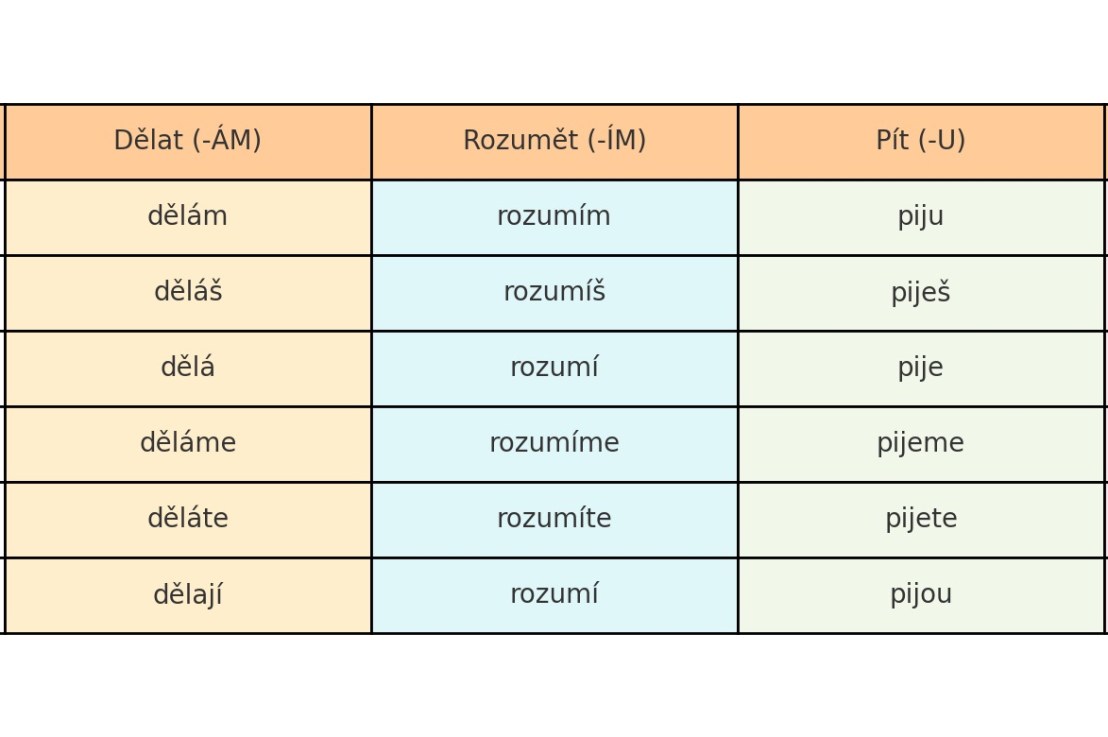
There are three basic types of verb conjugation in Czech:
Each type has its own set of endings for different verb tenses.
| Koncovka -at, -át | Koncovka -it, -et, -ět | Koncovka -ovat | |||
| dělám děláme | mluvím mluvíme | studuju (-i) studujeme | |||
| děláš děláte | mluvíš mluvíte | studuješ studujete | |||
| dělá dělají | mluví mluví | studuje studujou(-í) | |||
| mít | spát | psát | |||
| mám máme | spím spíme | píšu píšeme | |||
| máš máte | spíš spíte | píšeš píšete | |||
| má mají | spí spí | píše píšou | |||
-at Verbs (1st Conjugation):
1. Verbs ending in “-at” belong to the first conjugation. To conjugate these verbs, you remove the “-at” ending and add the appropriate endings. For example, the verb “mluvit” (to speak): – Present tense: mluvím (I speak), mluvíš (you speak), mluví (he/she/it speaks) – Past tense: mluvil jsem (I spoke), mluvil jsi (you spoke), mluvil (he/she/it spoke) – Future tense: budu mluvit (I will speak), budeš mluvit (you will speak), bude mluvit (he/she/it will speak)
- Infinitive Ending: –at, -át – example: “čekat” (to wait)
- Present Tense:
- Singular: čekám, čekáš, čeká
- Plural: čekáme, čekáte, čekají
- Past Tense:
- Singular: čekal/čekala, čekal/čekala, čekal/čekala
- Plural: čekali/čekaly, čekali/čekaly, čekali/čekal
- Present Tense:
-it, -et, -ět Verbs (2nd Conjugation):
2. Verbs ending in “-it” belong to the second conjugation. To conjugate these verbs, you remove the “-it” ending and add the appropriate endings. For example, the verb “psát” (to write): – Present tense: píšu (I write), píšeš (you write), píše (he/she/it writes) – Past tense: psal jsem (I wrote), psal jsi (you wrote), psal (he/she/it wrote) – Future tense: budu psát (I will write), budeš psát (you will write), bude psát (he/she/it will write)
- Infinitive Ending: -it, -et, -ět
- Example: “mluvit” (to speak)
- Conjugation:
- Present Tense:
- Singular: mluvím, mluvíš, mluví
- Plural: mluvíme, mluvíte, mluví
- Past Tense:
- Singular: mluvil/la, mluvil/la, mluvil/la
- Plural: mluvili/ly, mluvili/ly, mluvili/ly
- Present Tense:
-ovat Verbs (3rd Conjugation):
3. Verbs ending in “-et” belong to the fourth conjugation. To conjugate these verbs, you remove the “-et” ending and add the appropriate endings. For example, the verb “jíst” (to eat): – Present tense: jím (I eat), jíš (you eat), jí (he/she/it eats) – Past tense: jedl jsem (I ate), jedl jsi (you ate), jedl (he/she/it ate) – Future tense: budu jíst (I will eat), budeš jíst (you will eat), bude jíst (he/she/it will eat)
The fourth class of verbs end in -out or -ci such as:
| Present Singular | Present Plural | |
|---|---|---|
| 1st person | peču | pečeme |
| 2nd person | pečeš | pečete |
| 3rd person | peče | pečou |
Irregular Verbs (Slovesa nepravidelná): Irregular verbs in Czech do not follow the standard conjugation patterns. They have unique forms for different tenses and persons. Examples include “jít” (to go), “být” (to be), and “mít” (to have).
Sloveso být
1. Přítomný čas
| Osoba | Tvar |
| já | jsem |
| ty | jsi / jseš |
| on/ona/ono | je |
| my | jsme |
| vy | jste |
| oni | jsou |

 Czech 🚀