The Vilnius kenasa is located in a two-storey neighborhood in the Žvėrynas quarter, in Polish Zwierzyniec = once the game reserve of the local nobility.
The Karaim are a people of Turkic origin who, according to tradition, were brought to Lithuania by the Lithuanian Grand Duke Vytautas, Witold in Polish, during one of his military expeditions to the Crimea at the end of the 14th century. Several hundred Karaim families settled in Trakai and its surroundings (Vilnius itself is about 30 km from Trakai). Today, Trakai is considered the capital of the Lithuanian Karaims.
The Karaim have their own prayer houses – kenesas. According to some, the word kenesa comes from the Hebrew kenes (כֶּנֶס) – assembly, or the Arabic word kanisa (كَنِيسَة) meaning non-Muslim prayer house (or church).
The old kenesas, which were mostly wooden, have not survived. There are only two kenesas in Lithuania today, the newer one in Vilnius and the older one in Trakai.
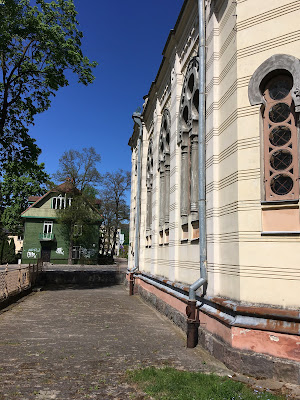
The construction of the kenesa was started in 1911 in the Moorish style (in which many shrines were built, including the Jerusalem Synagogue in Prague, synagogues in Františkovy Lázně, Lancashire and Vienna) according to the project of architect Mikhail Prozorov. Inside, the kenesa is divided into three parts: the main prayer hall for men, the gallery for women, and the center. At the east wall is an echal, a torah box, also in the Moorish style.
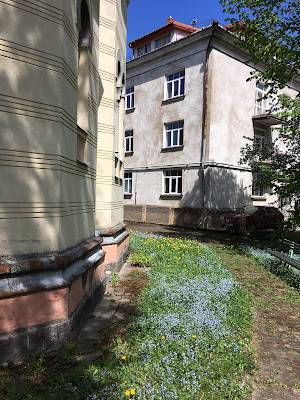
After overcoming the low fence, the building can be walked around in the inner yard. There are no signs of any busy religious life. According to two-year-old data, 273 Karaites live in Lithuania: about half of them – 138 – in Vilnius, 65 – in Trakai, 31 in the city of Panevėžys, 6 in Grigiškės, 4 each in Kaunas, Lentvaris and Noreikiškės.
The Karaim (Karaite) religion is sometimes compared to Protestantism, because just as the Protestants it relies on the authority of the Bible only – of course, in this case the part of it called the Old Testament by Christians. We are not misled by the Jewish stars and Hebrew inscriptions on the building and inside – this belief is indeed a sort of Judaism.
The entrance to the temple is on the north side. When praying, men are usually on the ground floor, women in the attic. In the “lobby” (azar) it is obligatory to take off your shoes. The main prayer rooms (shulchan) feature low ceilings, carpeted floors and wooden benches.
Kenasa is reportedly undergoing restoration and is not accessible.
Kenasa is actually across the street (Liubarto g. 6, Vilnius 08118, Litva)
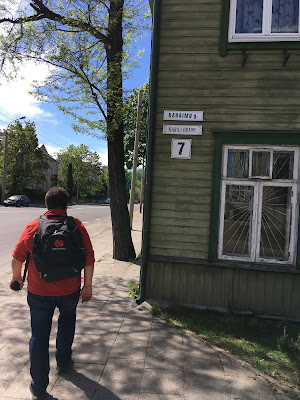
Karaimų gatvė – or Karaim Street – is already the eighth street in the Lithuanian capital, the name of which bears the name of an ethnic minority who live in Lithuania. It has been an initiative of Mayor Remigijus Šimašius, thanks to which Vilnius already has Islandijos gatvė, Vašingtono skveras, Varšuvos gatvė, Rusų gatvė, Žydų gatvė, Totorių gatvė, Vokiečių gatvė (perhaps only the last two need translation – Tatar and German streets).
⊗ ⊗ ⊗
There is an interesting video, where a group of Turkish visitors entered an other Lithuanian kenesa (probably the Trakai one) with a guide, a Lithuanian lady, who translated the Russian words of the object’s administrator to the group.
⊗ ⊗ ⊗ Video Insights
The featured video captures a group of Turkish visitors entering a Lithuanian kenesa (likely the one in Trakai, given the traditional wooden interior). A Lithuanian guide facilitates the visit by translating the administrator’s Russian explanation into Turkish for the group.
Key points from the video:
- Turkic Identity & Language: The video highlights the deep ethnic connection between the Karaim and Turkish people. The administrator confirms that ethnically, the Karaim belong to the Turkic group. The visitors are often surprised by the linguistic similarities they encounter.
- Religious Architecture: The guide explains that the altar (echal) in Karaite kenesas is always oriented towards the south, facing the Holy Land (Jerusalem).
- Interior Details: You can see the Decalogue (The Ten Commandments) on the walls and a beautiful ceiling painted like a starry sky. The administrator mentions that while the state protects the building as an architectural monument, it often lacks the funds for necessary restoration.
- Customs: The video mentions that, following Eastern traditions, women pray separately, either in a designated area or on the upper gallery.
- Liturgical Language: In the latter part of the video, you can hear traditional Karaite chanting, which showcases their unique liturgical music that blends Turkic phonetics with Jewish religious texts.
- History of the Building: The administrator shares that during the Soviet era, the building was nationalized and used for various secular purposes, including as a road administration office and later even as apartments, before being returned to the community and restored with the help of the Ministry of Culture.
Watch the video: Our visit to the Jewish Karaim Turks in Vilnius, Lithuania
Czech Language Lessons & Translations




 Czech 🚀